
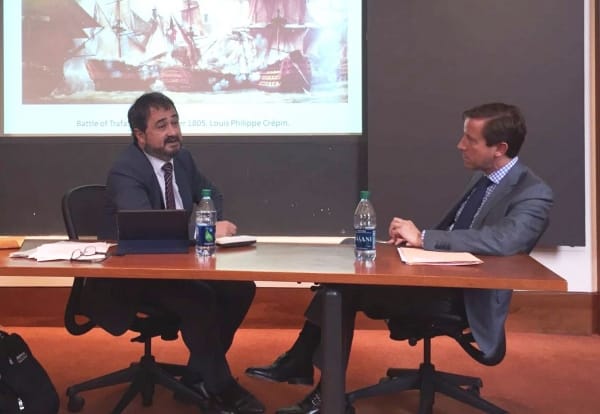
Panel on “Alternative Dispute Resolution From a Transatlantic Perspective”
Speakers:Henri Piffaut (Fellow, WCFIA Fellows Program. Civil Servant, DG Competition, European Commission); Francisco Málaga (Partner, Linklaters S.L.P.); Javier Íscar de Hoyos (Secretary General. European Arbitration Association).
Date:November 17, 2016
Ibero-American Arbitration Center (CIAR) Secretary General, Javier Íscar de Hoyos, provided an overview of the distinct scope and approach of this newly-created arbitration center. The center has been established to offer an alternative dispute resolution forum to the highly populated Ibero-American region (582 million of inhabitants), and its rising corporate ecosystem (14 million of companies) across 22 countries. As a testament of the latter, presently cross-border Ibero-American investment is well over USD 50,000 millions. The Headquarters of the General Secretariat is in Madrid, Spain. CIAR Secretary General Íscar de Hoyos went on to explain the historical, geographical, legal and cultural reasons why Ibero-America had never embarked on the journey of establishing its own arbitration center beforehand, as well as CIAR´s competitive advantages when compared to leading bodies for the resolution of international disputes by arbitration, such as the International Chamber of Commerce (ICC) International Court of Arbitration. Among CIAR´s strengths, CIAR Secretary General Íscar de Hoyos mentioned the language commonality in ICAR member countries, cultural convergence, compatible legal systems, ever-increasing economic activity and the adoption of the United Nations Commission on International Trade Law (UNCITRAL) Arbitration Rules as a basis for proceedings in line with the needs and conditions of modern international trade.
Dr. Francisco Málaga expanded on CIAR Secretary General Íscar de Hoyos intervention. In his view, the potential of CIAR is worth-highlighting, especially in a multi-court environment where an experienced and renowned regional arbitration institution of reference is much needed. Dr. Malaga focused the second part of his intervention on the present and future of arbitration in Spain. Despite a sound legal framework that follows the principles that undergird the UNCITRAL Model Law on International Commercial Arbitration has been adopted, a set of crucial factors need further consideration, including a prevailing mistrust toward arbitration as a tool to resolve disputes, a perceived lack of transparency in the selection of arbitrators, a myriad of court options, and the often times seemingly intrusive interpretation given to the concept of ordre public, all of which contribute to the continued primacy of in-court litigation as the preferred dispute resolution mechanism in Spain.
An interactive debate followed these first two interventions that touch upon the core principles that underpin the arbitration construct, such as inter alia the expertise, subject-matter specialization and conflicts of interest of arbitrations; the cost, quantity and quality of proceedings; and the enforcement and grounds of annulment of arbitral awards.
Following the debate, the panel shifted from Ibero-American commercial arbitration to European Commission decisions pursuant to anti-trust cases. European Commission Directorate-General for Competition (DG) civil servant,Henri Piffaut compared the main steps of the procedures leading to commitment (Article 9) and prohibition (Article 7) decisions based on Regulation 1/2003. DG´s Piffaut highlighted that the procedure for commitment decisions is generally shorter than for prohibition decisions. Further, DG´s Piffaut recounted the positive experience with settlement procedures aimed at simplifying the administrative procedure leading to adoption of a decision and reducing the number of appeals, thereby enabling the Commission to handle cases faster and more efficiently and increasing the overall procedural efficiency.
The panel concluded with a recollection of ideas that allowed both speakers and attendees exchange perceptions of the commonalities and divergences between dispute resolution mechanisms in different ambits from a comparative perspective.


